NeuroBridge
Clinician-gated AI exercise agent for upper-limb rehab
A clinical AI agent that drafts personalized rehab exercises from live muscle-activity data — gated by human-in-the-loop clinician review before anything reaches the patient. Runs on a native iOS app backed by a bilateral EMG wearable.
7 muscle groups
≥90% accuracy
clinician-gated AI
Stack
Swift / SwiftUI · ESP32 + BLE · Claude API · SwiftData · Swift Charts · MVVM · MyoWare EMG
the problem
Stroke and post-surgical rehab happens in a few minutes of clinic observation, then the patient goes home to a black box — no continuous data, no at-home monitoring, and no way to compare the affected limb against the healthy one, which is exactly the signal recovery hinges on.
how it works
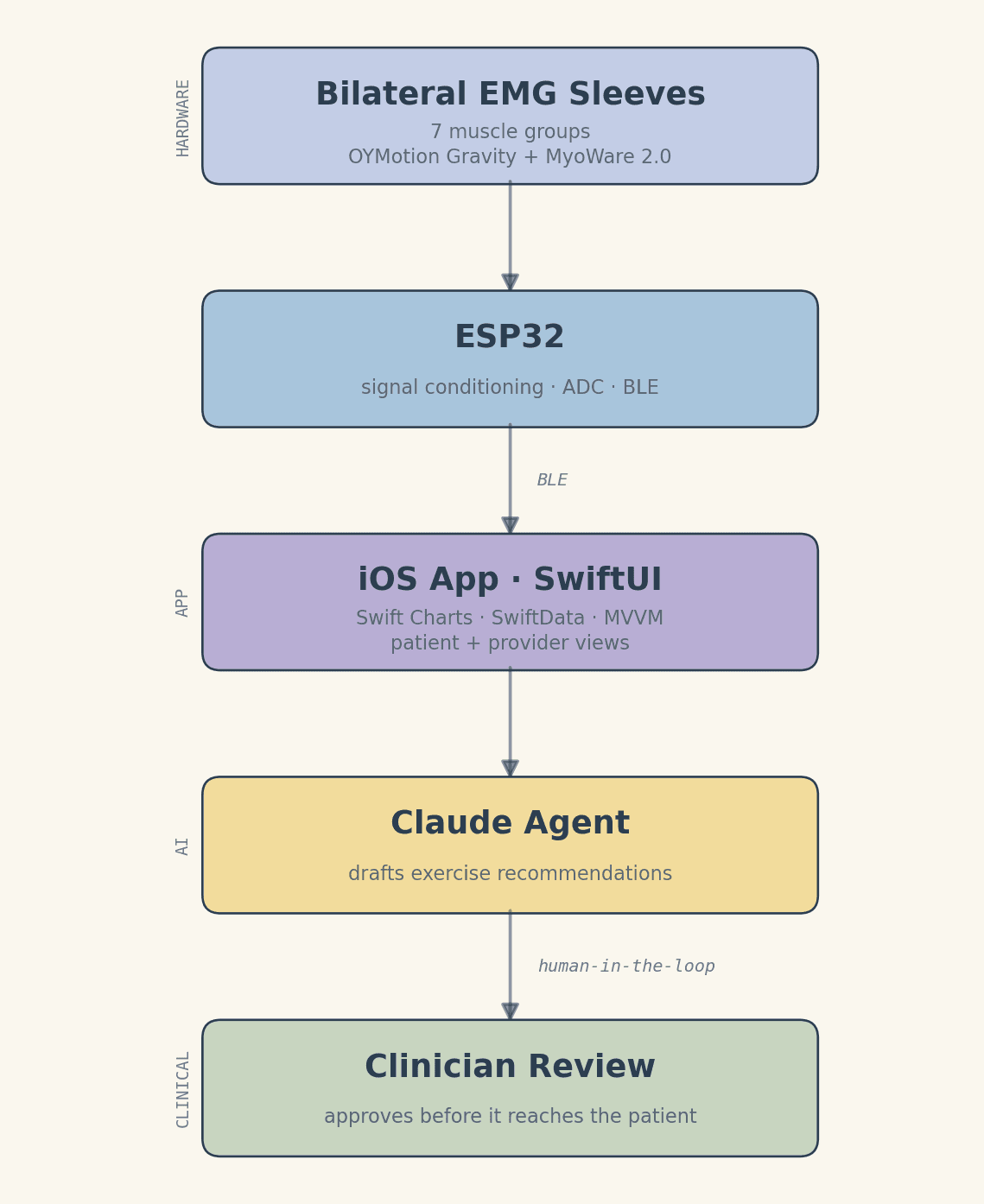
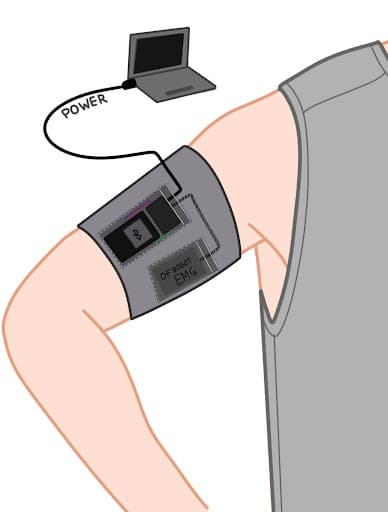
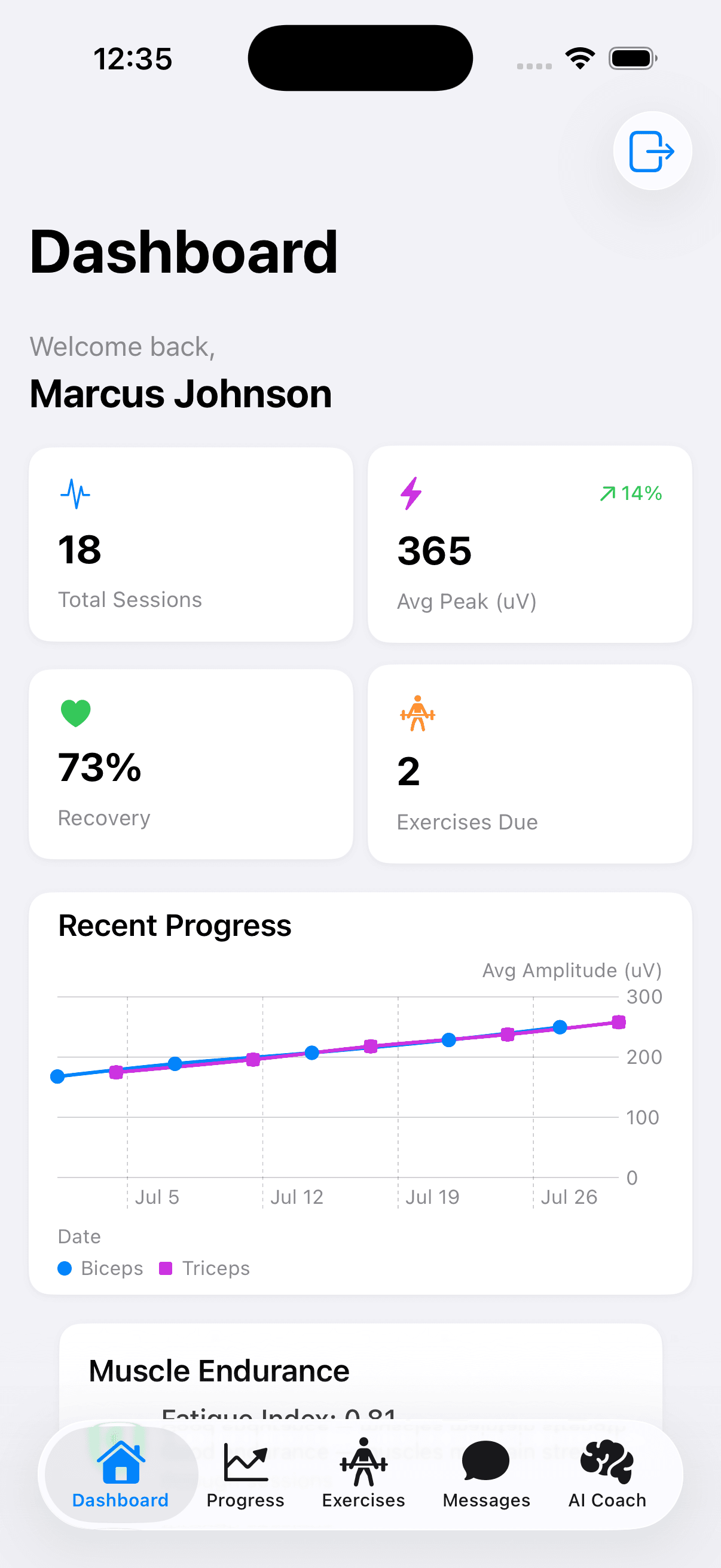
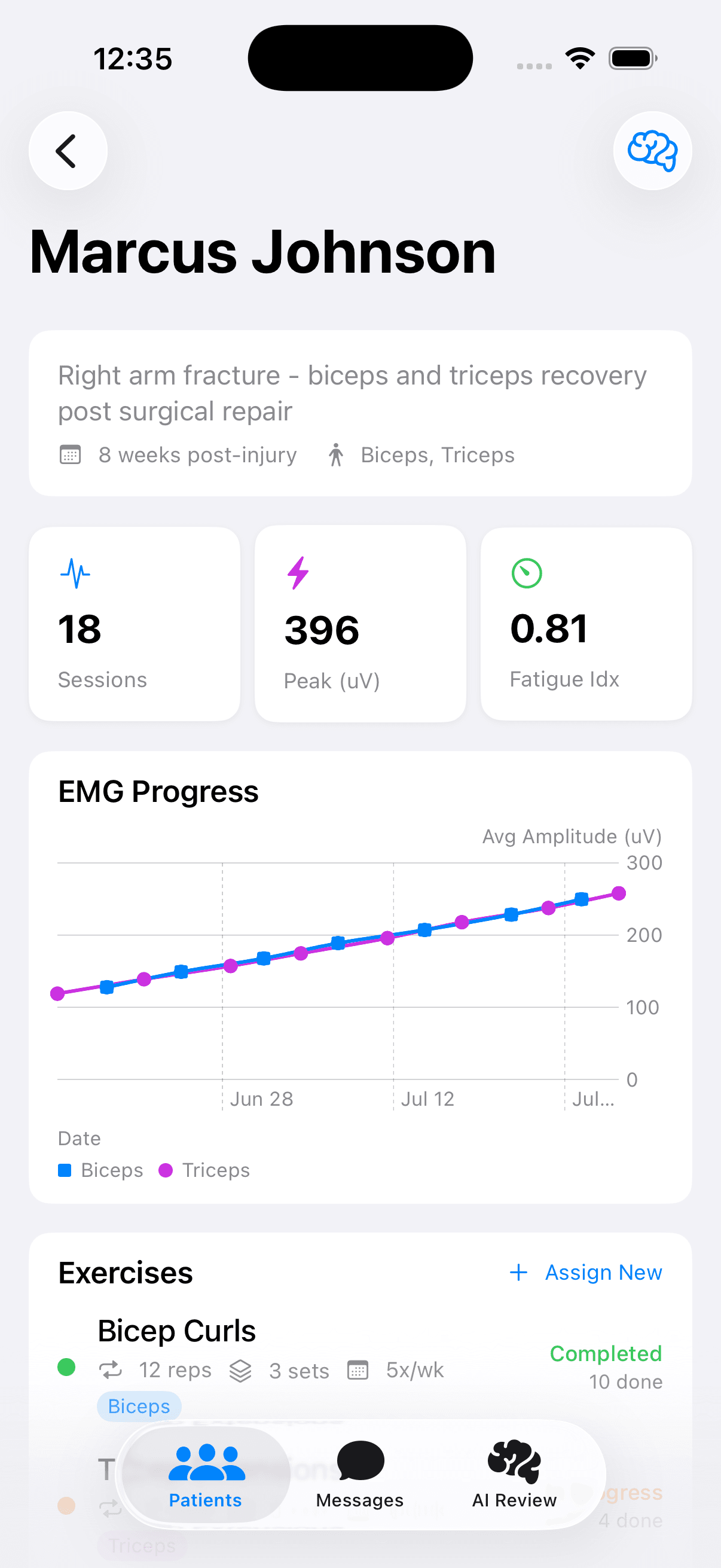
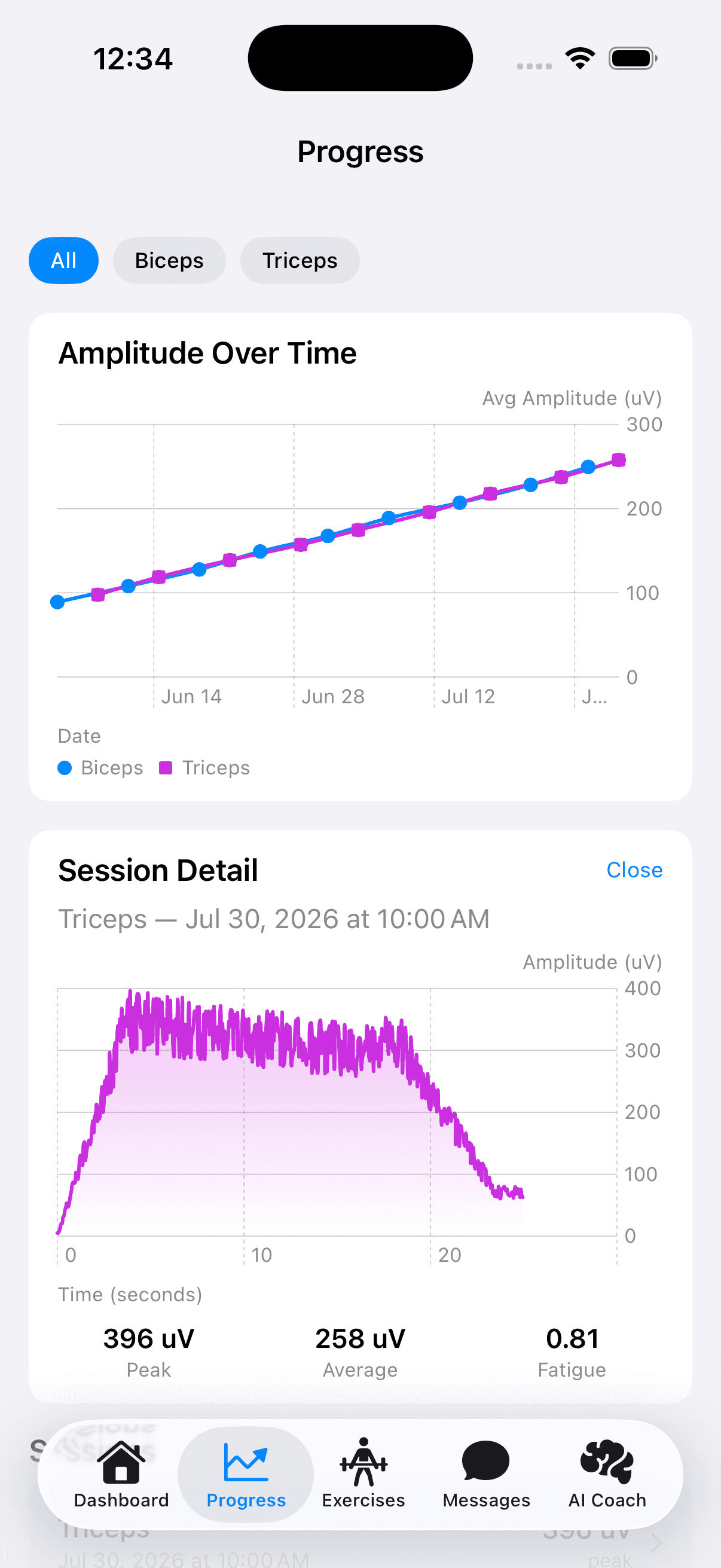
Two textile sleeves — one per arm — read muscle activity from seven muscle groups and stream it over Bluetooth. Each sleeve embeds surface EMG electrodes (OYMotion Gravity + MyoWare 2.0); an ESP32 handles signal conditioning, ADC, and BLE. A native Swift / SwiftUI app (SwiftData + Swift Charts) shows, in real time, how the recovering limb compares to the healthy one — in a patient view and a clinician view.
the claude agent
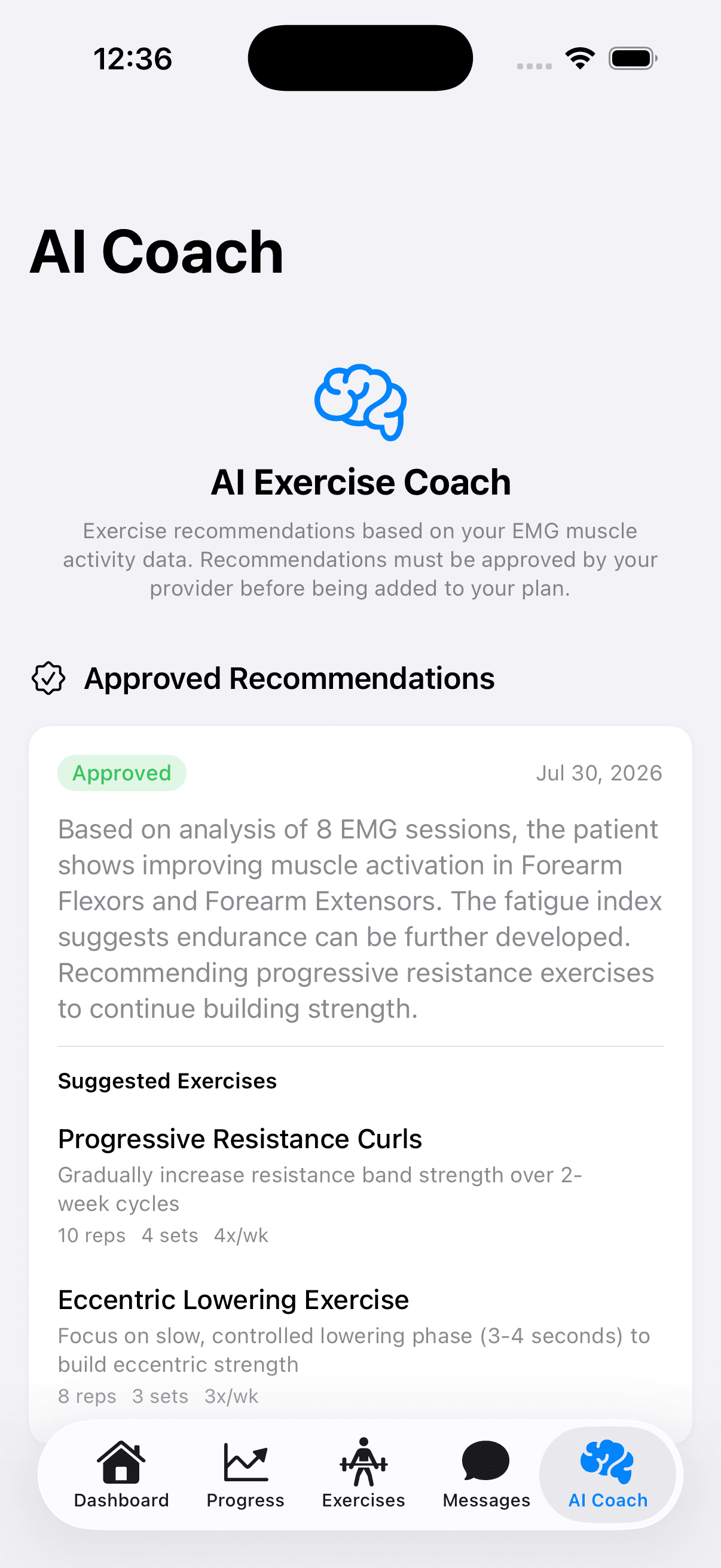
The recommendation engine is an agent built on the Claude API. It reads a patient's recent EMG history and drafts the next set of exercises — reasoning over trends, asymmetry, and progress the way a therapist would. But every plan is gated behind human-in-the-loop clinician review before it reaches the patient: Claude drafts, the clinician decides. That review gate is the whole reason a model can sit this close to a recovering patient safely — and it mirrors how a real prior-auth or triage agent has to work in a clinical setting.
my role
I designed and built the Claude-powered recommendation agent and its clinician-review workflow, built the iOS app with Claude Code as my primary dev tool, owned hardware-to-software integration off the ESP32's BLE stream, ran human-factors testing, and authored the 510(k) analysis — a Class II device mapped against ISO 13485, ISO 14971, and IEC 60601-1, with K-Myo (Kinvent) as the predicate.
more
key decisions
Clinician-in-the-loop, always
The AI never speaks to the patient directly. Every recommendation is drafted by Claude and gated behind a clinician's approval — the only safe way to put a model anywhere near a recovering patient.
Bilateral by design
Two sleeves, not one. The healthy limb is the baseline you measure recovery against, so symmetric sensing was the whole point — not a nice-to-have.
Native iOS, built with Claude Code
SwiftUI + Swift Charts gave us real-time clinical visualization with first-class performance. Claude Code as the primary dev tool let one person ship a clinical-grade app on a semester timeline.
Regulated from day one
We designed against 510(k), ISO 13485, and IEC 60601-1 from the first sketch instead of retrofitting compliance later — it changed hardware, software, and the AI workflow alike.
outcomes
- Human-in-the-loop AI — every Claude-drafted exercise plan is clinician-approved before it reaches the patient
- ≥90% target signal-acquisition accuracy across 7 muscle groups
- <100ms sensor-to-screen feedback latency
- Bilateral asymmetry detection validated under controlled, known imbalances
- FDA 510(k) pathway analysis with K-Myo (Kinvent) as predicate device
- Human-factors testing across multiple sessions
up next
AgentTrace
AI Agent Evaluation Tool